Travel Insights
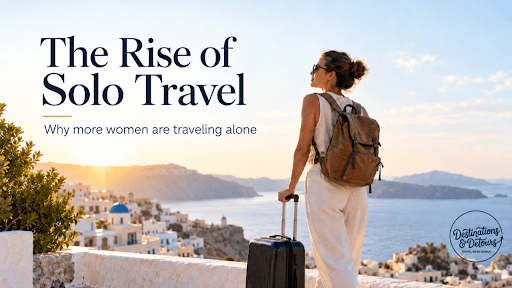
Somewhere along the way, traveling alone stopped meaning you had no one to travel with. It started meaning you were choosing yourself.
For generations, we have treated travel as something inherently social. Vacations meant spouses, families, friends, tour groups, or somebody sitting beside you on the plane. Going somewhere alone could even carry an uncomfortable implication that maybe you simply could not find anyone willing to go with you.
That perception is changing quickly. Solo travel has moved from the margins of tourism into one of its most interesting growth areas, and the numbers suggest this is much more than a passing trend. Skyscanner reports that hotel bookings using its solo traveler filter have jumped 83 percent year over year, while 39 percent of travelers have gone abroad, or considered doing so, partly to make new friends, date, or simply meet people.
Those numbers tell us something larger than who is occupying a hotel room. They suggest travelers are becoming increasingly comfortable saying, this trip can be about me, even if nobody else is coming.
The Freedom of Not Having to Compromise
Anyone who has planned a group vacation understands the negotiations involved. One person wants the museum, someone else wants the beach, another wants to sleep until noon, and inevitably somebody is hungry again even though you just ate.
Traveling with people we care about can be wonderful, but every shared trip requires some degree of compromise. Solo travel removes much of that. If you want to spend three hours wandering through a neighborhood because something caught your attention, you can. If a local recommends a tiny restaurant that was nowhere on your itinerary, you can change your plans. If you decide tomorrow should involve nothing more ambitious than coffee, a book, and watching the world go by, nobody else has to approve the motion.
That freedom is becoming increasingly important as travel itself grows more individualized. Booking.com's 2026 Travel Predictions, based on research involving more than 29,000 travelers across 33 countries and territories, found that travelers are increasingly building trips around their own interests, passions, and definitions of what makes an experience worthwhile. Sixty seven percent said they do not need a traditional reason to book a trip, while 75 percent said simply working hard and feeling they deserve a vacation is justification enough.
Solo travel may be one of the clearest expressions of that shift. Instead of asking everyone else when they are available, what they want to spend, and where they want to go, people are increasingly deciding that wanting the experience is reason enough.
Alone Does Not Mean Disconnected
One of the biggest misconceptions about solo travel is that traveling alone must be lonely. My own experiences have often shown me almost exactly the opposite.
Years ago, I was traveling alone and ended up talking with another solo traveler at a bar in St. Louis. During the conversation, she mentioned wanting to visit the Gateway Arch but admitted that she was nervous about the unusual tram system that carries visitors to the top. If you have never seen those little pods, calling them elevators is being generous. They are small, enclosed, and definitely not the traditional elevator experience.
She wanted to go, but she was afraid to do it alone, so we decided to visit the Arch together. I encouraged her through the ride, we made it to the top, and suddenly two people who had started the day as complete strangers were sharing an experience neither of us had planned.
On another solo trip, I was in Utah visiting Golden Spike National Historical Park, where the Union Pacific and Central Pacific railroads famously met. If you have been there, you know just how isolated that part of Utah can feel. While I was exploring, I came across a local family whose car had broken down in the middle of what felt like absolutely nowhere. I stopped and helped them, and afterward they invited me to have dinner with their family that evening.
Neither experience was on an itinerary. Neither was something I could have booked in advance. Yet both remain memorable precisely because I was traveling alone.
When we travel with other people, we naturally focus much of our attention inward toward our group. We talk to one another at dinner, navigate together, and experience a destination through an already established social circle. Traveling alone can change that dynamic completely. You notice more people. You are more approachable. You sometimes become more willing to start a conversation because there is nobody sitting across the table from you.
Skyscanner's research reflects that desire for connection. More than one third of travelers consider meeting new people an important motivator for taking a trip, and 39 percent have traveled abroad, or considered doing so, because of the possibility of friendship, dating, or simply meeting someone new.
There is a strange but beautiful paradox in solo travel: sometimes being by yourself makes you much more available to everyone around you.
Women Are Leading the Movement
Perhaps the most interesting part of the solo travel boom is who is driving so much of it. Women are not simply participating in solo travel. Across several segments of the industry, they dominate it. Virtuoso's 2025 Global Luxury Traveler Report found that 68 percent of its solo travelers are women. Road Scholar reports an even more striking figure: women represent 85 percent of its solo travelers.
Intrepid Travel is seeing something similar. Participation in its Women's Expeditions grew 32 percent during 2025, and 77 percent of those travelers joined the trip solo.
That challenges some deeply embedded assumptions about women and travel. Historically, conversations surrounding women traveling alone have often begun with warnings. Is it safe? Should she really be going there by herself? Wouldn't it be better to wait until someone can travel with her?
Safety absolutely matters, and responsible travel planning should never pretend otherwise. Destination, neighborhood, transportation, cultural expectations, communication, and access to support can all become especially important considerations for someone traveling independently.
But what is remarkable about the numbers is that women are clearly not interpreting safety considerations as a reason to stop traveling. Instead, many are becoming more informed, more prepared, and more willing to go anyway.
For generations of women who may have been taught, directly or indirectly, that travel required a partner, spouse, friend, or family member beside them, that represents a significant cultural shift.
Travel as an Act of Confidence
Solo travel can also provide something that is difficult to manufacture in ordinary life:
repeated evidence that you can figure things out yourself. Every trip contains dozens of small decisions. You navigate an unfamiliar airport, figure out transportation, choose where to eat, decide which street looks interesting, solve a problem when something inevitably changes, and determine what to do next without automatically looking at someone beside you for reassurance.
None of those actions sounds particularly heroic by itself. Collectively, though, they reinforce a powerful message: I handled it. That confidence can extend far beyond travel. The person who successfully navigates a foreign city alone, asks strangers for help when needed, adapts when the train gets canceled, or sits comfortably at a restaurant table for one may return home with a slightly different understanding of what they are capable of.
This may help explain why independence, self discovery, and personal growth appear so frequently in conversations about solo travel, particularly among women. For many travelers, the destination becomes only part of the experience. The other part is discovering how they respond when everything from today's schedule to tonight's dinner is entirely their decision.
Social Media Has Changed What Feels Possible
Technology and social media have also played an enormous role, particularly for younger women. For all the legitimate criticism surrounding social media and tourism, these platforms have allowed millions of people to watch someone like them do something they previously considered intimidating.
Skyscanner reports that 83 percent of Gen Z women say solo female travel content on social media has inspired them to consider traveling alone.
That kind of visibility matters. A woman scrolling through her phone can now see another woman navigating Tokyo by herself, hiking through Europe, joining a group tour alone, eating at a restaurant without a companion, or simply describing what she wished she had known before her first solo trip.
The message being communicated is simple but powerful: peoplelikemedothis. Perhaps that is one reason the rise of female solo travel feels different from earlier generations of independent travel. Women are not simply traveling alone. They are sharing information, safety advice, encouragement, destination recommendations, and stories with other women who may be considering the same thing.
Independence, strangely enough, has developed its own community.
The Travel Industry Needs to Understand the Difference
For those of us who work in travel, this trend should change the way we think about the solo traveler. A solo traveler is not simply half of a couple.
The questions are different. How comfortable is the neighborhood at night? How easy is the transportation system to navigate? Does the hotel create an environment where someone staying alone feels welcome? Are there opportunities to meet people without being forced into constant group activities? Is there access to someone who can help when a plan changes?
Cost matters too. The traditional travel model has frequently penalized people traveling alone through single supplements and pricing designed around double occupancy. As solo travel grows, companies that recognize the economic and experiential needs of these travelers will have an increasingly significant market to serve.
Virtuoso's 2026 Luxe Report shows the breadth of what solo travelers are seeking. Their most popular experiences include adventure and trekking, health and wellness, guided tours, cultural exploration, and culinary travel.
In other words, solo travelers are not asking for a watered down version of travel. They want the experience. They simply want it designed in a way that allows them to experience it independently and confidently.
Sometimes the Best Part Was Never on the Itinerary
There will always be trips I want to experience with the people I love. Solo travel is not a replacement for shared travel, nor does everyone need to prove something by boarding a plane alone.
But I understand why more people are doing it. Some of my favorite memories from solo travel did not happen because I was alone despite everyone else. They happened, at least partly, because I was alone. Being by myself made it easier to talk with another traveler in St. Louis who needed a little encouragement to conquer the Arch. It gave me the freedom to stop for a stranded family in rural Utah and later accept an invitation into their home for dinner.
Those moments remind me of something we sometimes forget when building itineraries and checking destinations off lists: travel is ultimately about people.
Sometimes those people are the ones who boarded the plane with you. Sometimes they are complete strangers you were never supposed to meet.
The continued rise of solo travel, and particularly the extraordinary growth of women choosing to travel independently, suggests that more people are becoming comfortable leaving room for both possibilities.
Maybe that is the greatest benefit of traveling alone. You get to decide where you are going, but you have absolutely no idea who you might meet along the way.
#SoloTravel #SoloFemaleTravel #WomenWhoTravel #TravelTrends #TravelIndustry #WomenInTravel #IndependentTravel #TravelConfidence #MeaningfulTravel #ExperientialTravel #HumanCenteredTravel #TravelAdvisor #TravelPlanning #AuthenticTravel #DestinationsAndDetours